 Add to Chrome
 Add to Firefox
 Add to Edge
Hista and Numca: Estimate State Value Effectively for LLM Reinforcement Learning
May 28, 2026
Reinforcement learning (RL) refines large language models (LLMs) by directly optimizing model behavior through reward signals. While accurate state value estimation is critical for stable training in classical RL, it remains an underexplored challenge in LLM post-training. In this work, we introduce the State Value Estimation Benchmark (SVEB) to assess state estimation within existing RL frameworks and show that critics in standard approaches like PPO collapse to a coarse group-average baseline. To address this, we propose two techniques: Numca, which leverages numerical spans as gradable milestones for state value estimation, and Hista, a framework that uses LLM's hidden states as representation to weighted average disjoint rollouts and their return. Extensive experiments demonstrate that both methods yield more accurate state value estimates and enhance training performance across different RL algorithms and model sizes without incurring significant computational overhead.

Knowing but Not Correcting: Routine Task Requests Suppress Factual Correction in LLMs
May 07, 2026LLMs reliably correct false claims when presented in isolation, yet when the same claims are embedded in task-oriented requests, they often comply rather than correct. We term this failure mode \emph{correction suppression} and construct a benchmark of 300 false premises to systematically evaluate it across eight models. Suppression rates range from 19\% to 90\%, with four models exceeding 80\%, establishing correction suppression as a prevalent and severe phenomenon. Mechanistic analysis reveals that suppression is not a knowledge failure: the model registers the error internally but task context diverts early-layer attention from the false claim as output intent crystallizes toward compliance at middle layers. We characterize this as \emph{knowing but not correcting} -- suppression occurs at response selection rather than knowledge encoding. Guided by this mechanism, we propose two training-free interventions. Correction Direction Steering (CDS) estimates a correction-compliance direction from matched pairs and injects it at middle layers before output intent crystallizes. Dynamic Payload Amplification (DPA) localizes payload tokens via attention divergence between early and late layers and amplifies their representation at the final layer, requiring no calibration data. Experiments on Qwen3.5-9B and LLaMA3.1-8B show both methods substantially improve factual strictness. CDS achieves the highest correction rate on Qwen3.5-9B (0\%$\to$58.2\%). DPA is the only method that preserves or improves reasoning capability on both models. These findings introduce \emph{factual strictness} -- the willingness to uphold accuracy against contextual pressures -- as a new dimension of model reliability.
Learning Human-Compatible Representations for Case-Based Decision Support
Mar 06, 2023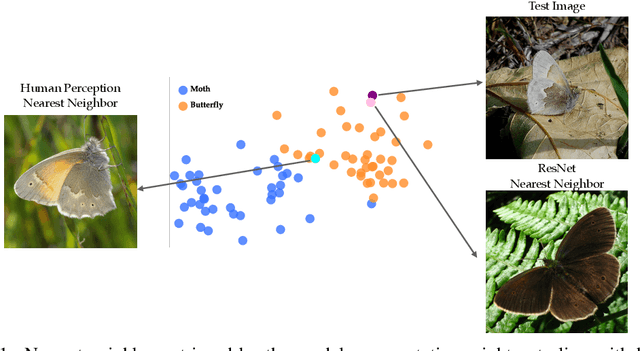
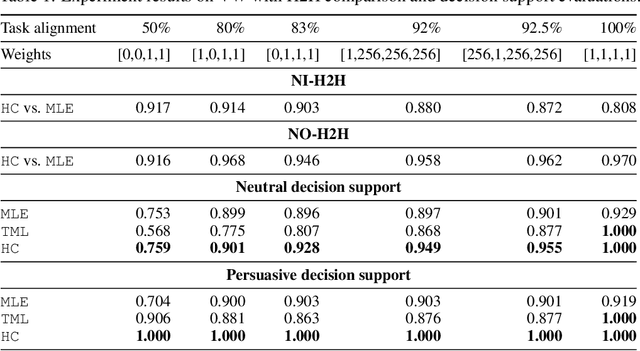


Algorithmic case-based decision support provides examples to help human make sense of predicted labels and aid human in decision-making tasks. Despite the promising performance of supervised learning, representations learned by supervised models may not align well with human intuitions: what models consider as similar examples can be perceived as distinct by humans. As a result, they have limited effectiveness in case-based decision support. In this work, we incorporate ideas from metric learning with supervised learning to examine the importance of alignment for effective decision support. In addition to instance-level labels, we use human-provided triplet judgments to learn human-compatible decision-focused representations. Using both synthetic data and human subject experiments in multiple classification tasks, we demonstrate that such representation is better aligned with human perception than representation solely optimized for classification. Human-compatible representations identify nearest neighbors that are perceived as more similar by humans and allow humans to make more accurate predictions, leading to substantial improvements in human decision accuracies (17.8% in butterfly vs. moth classification and 13.2% in pneumonia classification).